
The Shuttle Disaster That Almost Grounded NASA’s Dreams
Revisit a defining space-shuttle disaster and the technical, organizational and human decisions that forced NASA to reconsider the future of its program.
PBS Documentaries52 reviewed documentaries · Free to watchExplore missions, telescopes and discoveries that extend human knowledge beyond Earth, from the search for life on Mars to the physics of black holes.
Revisit a defining space-shuttle disaster and the technical, organizational and human decisions that forced NASA to reconsider the future of its program.
PBS Documentaries
Travel from collapsing stars to galactic centers to understand objects whose gravity traps light and may be essential to the structure of the universe.
NOVA PBS Official
Follow NASA’s Perseverance mission from launch to Jezero Crater in an ambitious search for evidence of ancient Martian life and samples for Earth.
NOVA PBS Official
Hey guys! We’re now live on Spotify 🎧 space,universe,cosmos,planets,nasa,space documentary,sun,national geographic,horrifying planets,spacex,voyager,exoplanets,top 5,ridddle,space facts,voyager 2,top 10,black hole,facts about space,mystery,jupiter,nasa discovery,earth,solar system,astronomy,saturn,mars,facts,strange,dangerous,objects,time Google's Willow quantum chip finished a calculation in under 5 minutes that would take one of the world's fastest supercomputers an estimated 10 septillion years. Yet ask the same chip to add two numbers, and an ordinary laptop wins. A quantum computer is no faster version of a normal computer. It holds information as amplitudes that can cancel, and it steers them so that wrong answers erase each other and the right answer grows stronger. That trick only works on problems with hidden structure, and it shows that the laws of physics decide what can be calculated. This documentary starts with bits and the double-slit experiment, then moves to amplitudes, qubits, superposition and entanglement, and why "trying every answer at once" is a myth. It covers the Holevo bound, Feynman's idea of simulating nature, Deutsch's universal quantum computer, Grover's search and its square-root limit, and Shor's factoring algorithm with the quantum Fourier transform. From there it looks at why
Late Science
Hey guys! We’re now live on Spotify 🎧 space,universe,cosmos,planets,nasa,space documentary,sun,national geographic,horrifying planets,spacex,voyager,exoplanets,top 5,ridddle,space facts,voyager 2,top 10,black hole,facts about space,mystery,jupiter,nasa discovery,earth,solar system,astronomy,saturn,mars,facts,strange,dangerous,objects,time In February 2023, astronomers using the James Webb Space Telescope reported six red galaxies, some of which seemed to hold as many stars as our Milky Way, seen when the universe was barely 600 million years old. Later, Webb confirmed a galaxy shining just 280 million years after the Big Bang, already rich in elements that only earlier stars could have made. Headlines said Webb was finding things older than the universe. None of it is. These objects are young but look grown-up too early. Part of the reason is how astronomers read faint light, and part is a young universe that built galaxies and black holes faster than expected. What is at stake is the story of how the first galaxies and black holes formed. This video starts with how Webb reads redshift and dates faint smudges, why one "redshift 16" galaxy turned out to be much closer, and how astronomers weigh galaxies by their light. It checks
Late Science
Hey guys! We’re now live on Spotify 🎧 space,universe,cosmos,planets,nasa,space documentary,sun,national geographic,horrifying planets,spacex,voyager,exoplanets,top 5,ridddle,space facts,voyager 2,top 10,black hole,facts about space,mystery,jupiter,nasa discovery,earth,solar system,astronomy,saturn,mars,facts,strange,dangerous,objects,time On August 25, 2012, Voyager 1 crossed the edge of the Sun's bubble about 11 billion miles from Earth, and its instruments disagreed. Particles from the Sun vanished and galactic cosmic rays poured in, yet the magnetic field kept pointing the same way it always had. Now, as Voyager 1 reaches one light-day from Earth on November 18, 2026, the data still overturn the old picture. The Sun's edge is a thick, layered, leaky border, and the space beyond it is denser and hotter than predicted. That changes how we understand the shield that keeps most galactic radiation away from Earth. This calm, long-form documentary follows Voyager from the termination shock in 2004, through the missing source of anomalous cosmic rays, the dented southern side of the bubble, the stalled solar wind and the magnetic highway, to the broken plasma instrument and the clever trick that measured interstellar density by listening to the gas ring. It then explores the
Late Science
In almost every deep image the James Webb Space Telescope takes of the early universe, there are tiny red dots. Astronomers have catalogued hundreds of them, most seen more than 12 billion years ago, and one shines about 100 billion times brighter than a star from a cloud roughly the size of our solar system. The leading explanation is a "black hole star": a young black hole wrapped in gas so thick it glows like the surface of a giant, cool star. If it holds, it may explain how the giant black holes at the centers of galaxies, including our own, were born. This calm, long-form documentary follows the little red dots from the first "universe breaker" galaxies to the clues that broke that reading: missing X-rays, steady light, absent dust and a spectrum that always turns at hydrogen's Balmer limit. It then explores dense-gas Balmer breaks, the Cliff, water vapor in the dots, black hole star one, the Eddington limit and the old quasi-star prediction. It ends with the dispute over black hole masses, the first direct weighing, the
Late Science
Hey guys! We’re now live on Spotify 🎧 space,universe,cosmos,planets,nasa,space documentary,sun,national geographic,horrifying planets,spacex,voyager,exoplanets,top 5,ridddle,space facts,voyager 2,top 10,black hole,facts about space,mystery,jupiter,nasa discovery,earth,solar system,astronomy,saturn,mars,facts,strange,dangerous,objects,time In 2024, the James Webb Space Telescope finished re-checking about a thousand pulsing Cepheid stars that Hubble had used to measure how fast the universe is expanding. Astronomers hoped Webb would expose a mistake. Instead it confirmed Hubble: nearby galaxies say about 73 kilometers per second per megaparsec, while the early universe predicts about 67. The easiest explanation, a measurement error, is now gone. If both numbers are right, our account of how the infant universe became today's cosmos is missing a piece. This calm, long-form documentary follows the expansion rate from Henrietta Leavitt's pulsing stars and Edwin Hubble's first, badly wrong estimate, through the afterglow of the Big Bang and the frozen sound waves that act as a cosmic ruler. It climbs the distance ladder from parallax and water masers to exploding white dwarfs, then follows Webb's tests of crowded Cepheids and a background-free "perfect host" galaxy. Along the way it covers the Chicago-Carnegie red giant result, surface
Late Science
Hey guys! We’re now live on Spotify 🎧 space,universe,cosmos,planets,nasa,space documentary,sun,national geographic,horrifying planets,spacex,voyager,exoplanets,top 5,ridddle,space facts,voyager 2,top 10,black hole,facts about space,mystery,jupiter,nasa discovery,earth,solar system,astronomy,saturn,mars,facts,strange,dangerous,objects,time The universe is about 13.8 billion years old, yet about eight in ten of its stars have barely started to age. The smallest will shine for more than 10 trillion years, and the largest black holes may last a googol years, a 1 followed by 100 zeros. If dark energy stays constant, the universe never truly ends. It fades, stage by stage, across spans our brains were never built to grasp. That makes our moment rare: we live in the brief, bright opening when stars, planets and the afterglow of the Big Bang can all be seen. This calm, long-form journey starts with why big numbers fool the brain and how scientists count time in zeros. It moves through the brightening Sun and the end of Earth's oceans, the uncertain Milky Way and Andromeda merger, and the dimming of the universe today. It follows red dwarfs burning for trillions of years, the last star ever born, galaxies evaporating, dark
Late Science
Hey guys! We’re now live on Spotify 🎧 space,universe,cosmos,planets,nasa,space documentary,sun,national geographic,horrifying planets,spacex,voyager,exoplanets,top 5,ridddle,space facts,voyager 2,top 10,black hole,facts about space,mystery,jupiter,nasa discovery,earth,solar system,astronomy,saturn,mars,facts,strange,dangerous,objects,time Right now, a radio message to Voyager 1 needs almost a full day to arrive, even at the speed of light. Launched in September 1977, it has flown for 49 years at about 38,000 mph and is now roughly 16 billion miles away, farther than anything humans have ever built. In 2012 it crossed into interstellar space. And yet, by the definition most astronomers use, Voyager 1 is still inside our solar system. The solar system has more than one edge, and the outermost one lies thousands of years ahead. Where those edges sit decides what shields our planets, and how far we really live from other stars. This calm, long-form documentary follows Voyager 1 outward through every boundary of the Sun's realm: the rare planetary alignment that launched it, the Jupiter and Saturn flybys that gave it escape speed, the Pale Blue Dot, the solar wind and the termination shock, the year-long debate over whether it had left
Late Science
Hey guys! We’re now live on Spotify 🎧 space,universe,cosmos,planets,nasa,space documentary,sun,national geographic,horrifying planets,spacex,voyager,exoplanets,top 5,ridddle,space facts,voyager 2,top 10,black hole,facts about space,mystery,jupiter,nasa discovery,earth,solar system,astronomy,saturn,mars,facts,strange,dangerous,objects,time Right now, the black hole at the center of our galaxy is flickering. The James Webb Space Telescope watched Sagittarius A* for 48 hours across a year and never once saw it rest. Faint flickers came and went in seconds, and bright flares erupted five or six times a day. Yet this restless giant, about 4 million times the mass of the Sun, gives off the light of only a few hundred Suns. It sits surrounded by fuel, including metal-rich gas that should cool and fall in easily, and swallows almost none of it. Why it refuses that fuel shapes how calm our galaxy has been, and how calm it stays. This calm documentary follows the story from Karl Jansky's mysterious radio hiss to the stars that weighed the black hole and the first image of its glowing ring. From there it moves to Webb's two-color stare and the cooling electrons hidden in its flares, the first mid-infrared flare
Late Science
Hey guys! We’re now live on Spotify 🎧 space,universe,cosmos,planets,nasa,space documentary,sun,national geographic,horrifying planets,spacex,voyager,exoplanets,top 5,ridddle,space facts,voyager 2,top 10,black hole,facts about space,mystery,jupiter,nasa discovery,earth,solar system,astronomy,saturn,mars,facts,strange,dangerous,objects,time On the way to Mars, a single day in deep space gives the human body about as much radiation as many months of ordinary life on the ground. A detector riding inside the spacecraft that carried the Curiosity rover measured close to 2 millisieverts every day. Over the travel legs of one round trip, that adds up to about 660 millisieverts, more than the entire career limit set for American astronauts. Radiation is only one of the clocks. Bones, muscles, eyes, food, medicine and machines all wear down by the day, and the orbits of the planets decide how many days a Mars mission must last. Whether people ever reach Mars may depend more on surviving the calendar than on crossing the distance. This calm, long-form documentary follows that clock from start to finish. We begin with the launch windows that open every 26 months and the two basic shapes of a Mars round trip. Then we look at
Late Science
Hey guys! We’re now live on Spotify 🎧 space,universe,cosmos,planets,nasa,space documentary,sun,national geographic,horrifying planets,spacex,voyager,exoplanets,top 5,ridddle,space facts,voyager 2,top 10,black hole,facts about space,mystery,jupiter,nasa discovery,earth,solar system,astronomy,saturn,mars,facts,strange,dangerous,objects,time Every picture of our galaxy or the universe seen from above is an illustration, because no camera has ever left the Milky Way. In November 2026, Voyager 1, our farthest spacecraft, reaches one light-day from Earth after nearly 50 years. The galaxy is about 100,000 light-years wide, and at Voyager's speed, rising high enough to see it whole would take almost 2 billion years. We live inside the thing we want to see, and the universe itself has no outside to stand in. Yet astronomers have mapped it anyway, from one small spot, and how they did it shapes everything we believe about our place in space. This documentary follows that journey step by step: the first photo of Earth from space, Voyager's Pale Blue Dot, the scale of the Milky Way, Herschel's star counts and the dust that fooled him, parallax and Leavitt's pulsing stars, Shapley's globular clusters, radio maps of hydrogen, a parallax measured to the far
Late Science
Hey guys! We’re now live on Spotify 🎧 space,universe,cosmos,planets,nasa,space documentary,sun,national geographic,horrifying planets,spacex,voyager,exoplanets,top 5,ridddle,space facts,voyager 2,top 10,black hole,facts about space,mystery,jupiter,nasa discovery,earth,solar system,astronomy,saturn,mars,facts,strange,dangerous,objects,time Blue dwarfs are stars astronomers have described down to their color and brightness, yet not a single one exists anywhere in the universe. About 3 of every 4 stars in our galaxy are red dwarfs, the stars that will one day become blue dwarfs, but they burn so slowly that the first blue dwarf needs roughly a trillion years to appear. That is about 70 times the present age of the universe. When these small stars finally grow old, they stay compact, heat up and glow blue-white instead of swelling into red giants. It means the age of stars has barely begun. This calm, long-form journey starts with the red dwarfs all around us and the nearest star, Proxima Centauri. It explains why small stars burn so slowly and why full-body mixing lets them use nearly all their fuel. It shows how the Gaia spacecraft revealed the boundary where that mixing begins, and why an opacity wall forces the
Late Science
Hey guys! We’re now live on Spotify 🎧 space,universe,cosmos,planets,nasa,space documentary,sun,national geographic,horrifying planets,spacex,voyager,exoplanets,top 5,ridddle,space facts,voyager 2,top 10,black hole,facts about space,mystery,jupiter,nasa discovery,earth,solar system,astronomy,saturn,mars,facts,strange,dangerous,objects,time One of the largest black holes ever found sits inside a quasar called Ton 618, and astronomers estimate it weighs about 66 billion suns, roughly the mass of every star in our Milky Way. Its edge would stretch more than 40 times farther than Neptune's orbit. Other giants, weighed in completely different ways, come in near 40 billion suns. Together they reveal something deeper: a natural ceiling on how large a black hole can grow, and a limit that shaped how the biggest galaxies in the universe formed. In this calm, long-form science documentary, we climb the black hole ladder from dead stars to ultramassive giants. We measure the size of an event horizon, discover why the largest black holes are thinner than air, and see how the first black hole image was made. We follow how astronomers weighed Sagittarius A*, Holmberg 15A, Ton 618 and the Cosmic Horseshoe, and why their methods disagree. Then we explore Phoenix A
Late Science
Hey guys! We’re now live on Spotify 🎧 space,universe,cosmos,planets,nasa,space documentary,sun,national geographic,horrifying planets,spacex,voyager,exoplanets,top 5,ridddle,space facts,voyager 2,top 10,black hole,facts about space,mystery,jupiter,nasa discovery,earth,solar system,astronomy,saturn,mars,facts,strange,dangerous,objects,time In December 2024, a Google quantum computer finished a calculation in under five minutes that would keep one of the world's fastest supercomputers busy for about ten septillion years, roughly seven hundred trillion times the age of the universe. It broke no law of physics to do it. What it bent are habits we learned from ordinary computers: that a bit holds one value, that information copies freely, and that every computer is a faster or slower version of every other. The answer reaches the locks that guard the internet and the question of why some problems are hard at all. This calm, long-form documentary starts with what that benchmark really proved, then explains qubits, interference and the Nobel-winning circuit that showed quantum behavior at a size you can hold. It moves through decoherence, the no-cloning theorem, quantum error correction and Google's Willow chip, giant atom arrays at Caltech and Harvard, entanglement and the experiments that ruled out hidden
Late Science
Hey guys! We’re now live on Spotify 🎧 620 light-years away, a world with no sun is swallowing 6 billion tons of gas every second. It glows. It flares. It grows the way a newborn star grows. And astronomers still call it a planet. A planet should be simple. A round world that circles a star. But giants keep breaking that picture. Some weigh 10 times more than Jupiter. One circles a star so small it should never have built it. Others drift through the Orion Nebula in pairs, with no star at all. So where does a planet end? Scientists drew a line at 13 times the mass of Jupiter. Past that point, a world's core can burn a rare, heavy form of hydrogen. Many researchers now say that line is arbitrary. Today we visit 4 giants wrapped in carbon dioxide skies, a famous failed star that turned out to be twins, and a planet hotter than many stars. Before we go, a quick tip. Want to watch or listen to our videos earlier, with no ads? Scan the
Late Science
Hey guys! We’re now live on Spotify 🎧 500 million years after the Big Bang, one black hole already weighed as much as 300 million Suns. That should be impossible. Black holes grow by eating, and physics puts a speed limit on how fast they can eat. Start with a black hole left behind by a dead star. Feed it as fast as the rules allow. It still needs around 700 million years of nonstop eating to become a giant. These monsters had far less time. Since 2022, the James Webb Space Telescope has spotted giant after giant at the dawn of time. Tonight, we follow 8 of them. We meet a black hole eating 40 times faster than the limit. We find a sleeping giant as heavy as 40 percent of the stars in its galaxy. We weigh a lonely black hole that may be older than its own galaxy. The computer models said these objects should be far smaller. So what happened in those first dark years? Before we find out, you can watch and listen to our
Late Science
Hey guys! We’re now live on Spotify 🎧 Picture a patch of sky with nothing in it. No stars. No light. Nothing your eye could ever catch. The James Webb Space Telescope aimed at that dark patch and held its gaze for 100 hours straight. What came back rewrote the story of how the universe began. Hidden inside that darkness sat thousands of galaxies, packed into a patch of sky smaller than a grain of sand held at arm's length. One of them formed just 290 million years after the Big Bang. It carries the mass of 500 million suns, and every model built before this image existed said a galaxy like it should be impossible this early. Tonight we walk through that patch of sky. We will meet the galaxy that broke every rule of when galaxies could exist. We will see how light alone lets scientists measure distance across billions of years. And we will watch record after record fall, as the darkness keeps giving up more than anyone expected. Want these stories early and without ads? Scan
Late Science
Hey guys! We’re now live on Spotify 🎧 Four decades ago, the American space agency launched a small metal probe with a golden record bolted to its side. Today, it drifts more than 12 billion miles from home, in a place no human instrument has explored: the space between the stars. In 2018, Voyager 2 crossed an invisible wall at the edge of our solar system and entered interstellar space. What it found broke the models scientists had trusted for decades. The plasma should have thinned to nearly nothing. Instead it grew thicker, denser than anything predicted. The magnetic field, the one Voyager was supposed to leave behind, still points the same way it did inside the solar system's bubble, as if the sun's grip reaches further than anyone imagined. Tonight we follow Voyager 2 past that border, into a region where the rules of our solar system stop making sense. Before we start, a quick word. If you love falling asleep to stories like this, find us on Spotify too. Scan the QR code on your screen, or press
Late Science
Discover the story of Pelé through the eyes of people who knew him. The story of the golden age for soccer in America and the fashion and the glam going around it. On August 28, 1977 the “King of Football” left his throne vacant. Pelé officially quit his job: mesmerizing the world. His last soccer jersey, “that” soccer jersey, became the shroud of the history of soccer. This is a journey through his last match, a long farewell reported by those who were there and left a mark not only on Pelé but also on an era. The story of the Cosmos who were “the” team of gods, the celebrities, the artists of soccer. ------- Chapters ▷ 00:00 - Pelé – The Greatest Footballer in the World ▷ 02:16 - Pelé Comes to New York ▷ 04:02 - The Man Behind the Legend ▷ 04:58 - The New York Cosmos Make an Impossible Move ▷ 07:14 - Bringing Soccer to America ▷ 08:36 - Life Inside the New York Cosmos ▷ 09:57 - How Pelé Changed American Soccer ▷ 12:08
wocomoDOCS
Hey guys! We’re now live on Spotify 🎧 Every school lesson taught you the world is solid, fixed, and real. But right now, the chair you are sitting on is a cloud of probability, flickering in and out of existence billions of times every second. Physicists proved this decades ago, and most still cannot explain what it truly means. Some say the moon vanishes the instant nobody watches it. Others say every choice you make splits the universe into a fresh copy of itself. A few believe reality only becomes real once someone, somewhere, observes it. These ideas come straight from real experiments, run in real labs, producing numbers that refuse to make sense. Tonight we step into the strangest layer of existence ever uncovered. We will meet particles that seem to talk to each other faster than light. Worlds that split with every heartbeat. And a puzzle so deep that even Einstein spent his final years chasing it, and failed. Before we go further, scan the QR code on your screen, or press the link in the description. It
Late Science
FORTITUDE is a new documentary about the people, perils and promises behind the emerging space industry. Sparked by humanity’s unquenchable thirst for exploration, fuelled by capitalism’s insatiable hunger for profits and propelled by breathtaking technological advances, a New Space Renaissance is emerging. Fortitude uncovers how a few influential individuals with utopian ideas and vast fortunes are forging a trillion-dollar off-world industry, while inspiring millions of us back on Earth. This is the story of those who take the risks, invest the capital, and endeavor to turn science fiction into science fact. Documentary Central is the home for compelling documentaries tackling subjects like history, climate change, wildlife, conspiracy and more. Subscribe so you don't miss out Fortitude: Forging the Trillion Dollar Space Industry Your support fuels our exploration! Help us uncover new stories and share diverse voices by donating to our channel through Super Thanks! More amazing playlists Below! **This film is under non-exclusive license from Sideways. All rights reserved. All of the content on this channel is UNDER LEGAL LICENSE (We have written contracts) from various copyright holders and distributors.
Documentary Central
Hey guys! We’re now live on Spotify 🎧 Space does not get safer the farther you travel. It gets more violent, and the danger grows with every mile. 600 million miles out, gravity can rip a star apart, thread by thread, and swallow the pieces whole. Push further, and you find deserts of empty space so wide that light takes billions of years to cross them. Push further still, and time itself starts to slow down, then stop. We are traveling through 33 of the most extreme places space has to offer. You will watch a star die in slow motion. You will see what waits inside a black hole's event horizon. You will learn what happens when the entire universe finally goes dark. Before we begin, scan the QR code on your screen, or press the link in the description below. It takes you straight to our Spotify. Watch or listen to these episodes early, and completely free of ads. This part of the universe shows no mercy. Prepare yourself. We go deeper than you have ever gone before.
Late Science
Hey guys! We’re now live on Spotify 🎧 The Sun burns at 27 million degrees Fahrenheit. Every second, it pours out more energy than humanity could use in a million years. But a few hundred miles above our atmosphere, the temperature crashes to nearly 455 degrees below zero. You are standing next to the biggest furnace in the solar system, and you are freezing. How is that possible? We tend to believe heat spreads out, filling everything around it. But space doesn't work that way, and once you understand why, you'll see sunlight completely differently. Tonight, we travel to the dark side of the Moon, where temperature swings could kill an unprotected astronaut in minutes. We drop into the empty gaps between galaxies, colder and stranger than anything on Earth. And we uncover why your body would freeze and burn at the same time if you stepped into space without protection. Before we start, scan the QR code on your screen or tap the link in the description. It takes you to our Spotify, where you can listen to episodes
Late Science
Hey guys! We’re now live on Spotify 🎧 A machine the size of a refrigerator just did something no computer in history has ever done. It solved a problem in under 5 minutes, a problem so hard, the world's fastest supercomputer would need longer than the age of the universe to finish it. Scientists verified it. They published it in the world's top science journal. Google calls the chip Willow. Inside it, a new trick called Quantum Echoes just broke a wall scientists thought was permanent. We are about to show you how a chip smaller than your thumb can reverse time inside itself, listen for an echo, and measure the shape of a molecule atom by atom. You will see why this could crack the codes that protect your bank account. You will see why it could help build the next medicine that saves your life. You will see why some scientists think this same trick could one day help us understand black holes. Before we start, hit follow on Spotify. Scan the QR code on your screen, or
Late Science
Discover unpublished and rarely seen photographs from the Battle of Berlin in 1945, brought together in an exclusive collection for history enthusiasts. More than 200 historical photographs take you through the final days of the Third Reich and reveal scenes rarely shown in documentaries. Viewed from space, World War II was a gigantic transformation of the planet's map in just six years. It all began in September 1939, when Germany invaded Poland and triggered a war that quickly spread across Europe. From a global perspective, one could observe how borders changed at an extraordinary speed: Poland disappeared under German and Soviet occupations, while Germany conquered Denmark, Norway, the Netherlands, Belgium, and France. By 1941, much of continental Europe was directly controlled by the Third Reich or by governments allied with Berlin. But that same year, Hitler made a decision that would completely transform the war: he launched Operation Barbarossa against the Soviet Union, opening a gigantic front of thousands of kilometers from the Baltic Sea to the Black Sea. While Europe burned, the conflict turned into a true world war.
Der Kommandant English
We move around… always going faster and further. Whether it’s in the air or even in space, research is progressing and giving us the ability to travel. But this traveling has a significant impact on the planet. Indeed, 100,000 plane flights take place each day, which means more than 30 million per year around the world. The impact of air traffic on the environment has doubled in 20 years and air pollution is constantly increasing. At the same time, research is progressing and offering the first journeys into space to individuals. In light of this, could we possibly build airplanes that are less damaging to the environment? What will the planes and rockets of the future look like? How will we get around in the tomorrow’s world? Chapters ▷ 00:00 - Introduction ▷ 02:18 - Electric Planes, Airbus E-Fan ▷ 05:14 - Electric Engines vs. Heat Engines ▷ 08:44 - Green Taxiing System, EGTS ▷ 11:08 - Airplane Noise & Noise Reduction ▷ 14:51 - CFM International LEAP ▷ 18:17 - Scattering the Noise in Amsterdam ▷ 22:00 - Learning
wocomoDOCS
More than fifty years after the Apollo missions, the Moon is once again at the center of space exploration. In January 2019, China achieved a historic first: landing the Chang’e 4 probe on the far side of the Moon. This scientific breakthrough reignited global interest in lunar exploration and marked the beginning of a new space race. Why are the world’s major space powers returning to the Moon? To uncover the history of our Solar System? To search for frozen water hidden in lunar craters? To build future Moon bases, exploit lunar resources, or use the Moon as a stepping stone to Mars and deep space? This documentary investigates the new race to the Moon, from China’s Chang’e missions to NASA’s Artemis program, the Orion spacecraft and the future Gateway lunar station. In France, CNES and IRAP are working with the Chinese space agency CNSA to develop advanced instruments capable of studying the lunar surface and detecting water. In Europe, ESA is contributing to the next generation of exploration vehicles for the Artemis program. Blending science, geopolitics, cutting-edge technology and
wocomoDOCS
Inside the chaotic origins of the space program. CHASING THE MOON, a film by Robert Stone, reimagines the race to the moon for a new generation, upending much of the conventional mythology surrounding the effort. The series recasts the Space Age as a fascinating stew of scientific innovation, political calculation, media spectacle, visionary impulses and personal drama. Utilizing a visual feast of previously overlooked and lost archival material — much of which has never before been seen by the public — the film features a diverse cast of characters who played key roles in these historic events. Among those included are astronauts Buzz Aldrin, Frank Borman and Bill Anders; Sergei Khrushchev, son of the former Soviet premier and a leading Soviet rocket engineer; Poppy Northcutt, a 25-year old “mathematics whiz” who gained worldwide attention as the first woman to serve in the all-male bastion of NASA’s Mission Control; and Ed Dwight, the Air Force pilot selected by the Kennedy administration to train as America’s first black astronaut. PART ONE: A PLACE BEYOND THE SKY begins in 1957 and tracks the
American Experience | PBS
The Soviet Union’s first atomic bomb in 1949 set off a fierce Cold War arms and space race. Discover how nuclear weapons and rocket technology changed history forever. In this captivating episode, we dive into the dramatic events following the Soviet Union’s detonation of its first atomic weapon, Joe-1, in 1949. Learn how this pivotal moment shattered America’s nuclear monopoly and launched a high-stakes contest between superpowers. From espionage in the Manhattan Project to the secret efforts of Klaus Fuchs, the video traces the rapid escalation in nuclear and missile technology on both sides. You’ll explore the crucial roles of Wernher von Braun, the V2 rocket program, and the race to develop intercontinental ballistic missiles like the Atlas and R-7. We follow the parallel paths of American and Soviet innovation - from the tragic tale of Albert the monkey’s spaceflight to the triumph and panic of Sputnik’s launch in 1957. See how political shifts, such as Eisenhower’s presidency and Khrushchev’s reforms, shaped military strategy and scientific ambition. As NASA is born and the Van Allen Belt is discovered, the stakes
Real History
On April 17, 2026, engineers in California sent a command into the dark. It traveled for almost a full day. Then, 15 billion miles away, a sensor that had worked since 1977 went silent. Voyager 1 just lost one of its last working instruments. The farthest explorer humans ever built is running out of power. Its nuclear heart fades a little more every year. Each watt now decides what lives and what goes dark. You probably think of Voyager as a finished story. A famous probe from the past. However, the drama is happening right now, at the edge of everything we know. In this journey, we follow that last command. We ride a dying nuclear battery. We watch engineers gamble on a risky fix called the Big Bang. And we cross the invisible border where our Sun's power ends. Before we begin, one quick thing. You can watch and listen to our videos earlier, and without ads, on Spotify. Just scan the QR code on the screen, or press the link in the description. Settle in.
Late Science
In 1804 Napoleon created 18 'Marshals of the Empire', to serve as the senior officers of the Grande Armée. He created a further 8 before his abdication in 1814. A few were aristocrats, but others were the sons of shopkeepers or tailors. The most favoured became princes and kings. Among their ranks were legendary figures such as Marshals Lannes, Ney, Soult, Davout and Masséna, but also less well know figures like Pérignon, Brune and Moncey. Our series explores the lives of all 26 Marshals, and ranks them according to our own judgement of their achievements as Marshals. Visit our online bookshop to find great books on this and other topics: As a bookshop.org affiliate we earn from qualifying purchases while donating 10% of sales to support independent bookshops! 📚 Recommended reading (as an Amazon Associate I earn from qualifying purchases): Get 20% off an annual license with code EPICHISTORYTV_ANN 🎶 Additional music from Kevin MacLeod (incompetetch.com): 'Egmont Overture', Licensed under Creative Commons: By Attribution 3.0 Thank you to Alexander Averyanov for permission to use his artwork, 'Battle of Eylau' and
Epic History
A dagger fit for a king… forged from iron that fell from the sky. And that’s only the first surprise. In this episode, cutting-edge scans and chemical tests reopen Egypt’s darkest and brightest mysteries. See how XRF proves Tutankhamun’s dagger is meteoric iron and why a scarab in his breastplate traces back to desert glass from the Great Sand Sea. Then travel beneath Saqqara, where CT scans expose millions of animal mummies—some complete, some parts, some startlingly empty—and why they still mattered. Inside newly found embalmers’ workshops, a long-sought secret emerges as natron in solution rewrites how bodies endured millennia. At Giza, laser mapping and a grid of ancient post holes reveal equinox-aligned precision behind the Great Pyramid’s near-perfect build. Finally, forensic clues from Armana’s child graves point to brutal labor, hunger, and a killer still with us today, while ingenious portcullises and hidden passages show how pharaohs fought tomb robbers. Watch to uncover the science, the deception, and the devotion that shaped life, death, and eternity in ancient Egypt.
Timeline - World History Documentaries
🖥️ The INSANE Rise & Fall of MySpace - aka MySpace: The Movie (4K) USEFUL LINKS: Myspace was once the most visited website on the internet, even outranking Google. But in 2004 the myspace founders had a meeting with a young guy named Mark Zuckerberg who was offering to sell them his website, which was then called The Facebook. The price he wanted was $75 million dollars, but Myspace turned him down - and why wouldn’t they? At the time, Myspace was thriving, and was by far the most popular social media platform. So, how did Myspace go from being worth billions of dollars and one of the most loved sites on the internet, to being nothing but a nostalgic memory? With its quirky interface and customizable profiles, MySpace represents the road untaken - the path social media could have gone before Facebook crushed the competition. But the reasons Myspace failed are not what you might think. And the rise and fall of Myspace is certainly not your typical business story. This video is the truth about what happened to
MagnatesMedia
Hey guys! We’re now live on Spotify 🎧 You are about to see a planet twice as wide as Jupiter, and it should not be able to exist. Its clouds burn white hot, and its gravity is so weak that gas floats upward like smoke. Scientists have confirmed this giant stretches nearly 190,000 miles across, yet weighs so little that it would float if you built an ocean large enough to hold it. We are about to fly across its burning sky, dive through its shifting cloud layers, and uncover the physics that lets a planet grow this huge without tearing itself apart. First, a quick favor. Scan the QR code on your screen, or press the link in the description below. It takes you straight to our Spotify, where new episodes arrive first and play completely free of ads. Follow along, and you will always hear these stories before anyone else does. Now dim the lights. Prepare yourselves. We begin. Sources
Late Science
Hey guys! We’re now live on Spotify 🎧 Somewhere in the universe, a civilization just sent its final message. It might be crossing space right now, and we could receive it in 1,000 years, long after everyone who sent it is gone. Scientists call this the Fermi paradox: if life is common, where is everybody? One unsettling answer: intelligent life might not survive long enough to be found. Every civilization could be born, grow, reach for the stars, and vanish, all in a cosmic blink. Tonight we travel across dying stars, extinct alien empires, and the eerie silence that fills the space between them. We visit worlds where oceans turned to acid, planets whose suns exploded before anyone could escape, and the terrifying math behind civilizational collapse. 🎧 Listen ad-free and get new episodes early on Spotify: link in the description. Sources
Late Science
Sign up to IEEE and get 20% off with this link: Links to everything I do: Producer/Narrator: Brian McManus Writer: Malik Head of Production: Mike Ridolfi Editor: Dylan Hennessy Writer/Research: Josi Gold Animator: Eli Prenten Animator: Riley Brown Sound and Production Coordinator: Graham Haerther Sound: Donovan Bullen Thumbnail: Simon Buckmaster Head of Moral: Shia LeWoof References: Select imagery/video supplied by Getty Images Thank you to AP Archive for access to their archival footage. Thank you to my patreon supporters: Abdullah Alotaibi, Adam Flohr, Henning Basma, Hank Green, William Leu, Tristan Edwards, Ian Dundore, John & Becki Johnston. Nevin Spoljaric, Jason Clark, Thomas Barth, Johnny MacDonald, Stephen Foland, Alfred Holzheu, Abdulrahman Abdulaziz Binghaith, Brent Higgins, Dexter Appleberry, Alex Pavek, Marko Hirsch, Mikkel Johansen, Hibiyi Mori. Viktor Józsa, Ron Hochsprung
Real Engineering
Step onto the freezing 25,000 square kilometer expanse of Lake Winnipeg, where fifth-generation "Ice Vikings" battle temperatures dropping below -40 degrees - conditions that can get colder than the surface of Mars. In this high-stakes extreme survival documentary, commercial fishermen risk everything, navigating dangerously thin 3-inch ice and facing the very real threat of hypothermia to claim their share of a $25 million annual industry. Licensed to Little Dot Studios. WONDER is packed with binge worthy reality documentaries for hours of entertainment. Check out our hub of diverse and empowering stories which explore the extreme side of life!
Wonder
Links to everything I do: Producer/Writer/Narrator: Brian McManus Head of Production: Mike Ridolfi Editor: Dylan Hennessy Writer/Research: Josi Gold Animator: Eli Prenten Animator: Stijn Orlans Sound and Production Coordinator: Graham Haerther Sound: Donovan Bullen Thumbnail: Simon Buckmaster Head of Moral: Shia LeWoof Select imagery/video supplied by Getty Images Thank you to my patreon supporters: Oliver Olsen Gerard Maggiolino Hayley Ben Jay Maglione Vern Knowles Fergus Lynch Eric Lyness Claire Han C. Tran Casper Kroon Sasha Reid Nathan Baum Javier Soto Ciarán Eric S. John Monsees John C Monsees Jonathan Mayhew Grant Grossbier Alfred Holzheu
Real Engineering
Links to everything I do: Producer/Writer/Narrator: Brian McManus Writers: Malik Klalib and Brian McManus Head of Production: Mike Ridolfi Senior Editor: Dylan Hennessy Sound Design: Donovan Bullen Animators: Mike Ridolfi & Ratimir Rakuljic Select imagery/video supplied by Getty Images Thank you to my patreon supporters: Abdullah Alotaibi, Adam Flohr, Henning Basma, Hank Green, William Leu, Tristan Edwards, Ian Dundore, John & Becki Johnston. Nevin Spoljaric, Jason Clark, Thomas Barth, Johnny MacDonald, Stephen Foland, Alfred Holzheu, Abdulrahman Abdulaziz Binghaith, Brent Higgins, Dexter Appleberry, Alex Pavek, Marko Hirsch, Mikkel Johansen, Hibiyi Mori. Viktor Józsa, Ron Hochsprung
Real Engineering
This is not an invitation to be featured on Real Engineering. Our animation studio is operated entirely separately to Real Engineering to maintain journalistic integrity Select imagery/video supplied by Getty Images Thank you to AP Archive for access to their archival footage. Thank you to my patreon supporters: Abdullah Alotaibi, Adam Flohr, Henning Basma, Hank Green, William Leu, Tristan Edwards, Ian Dundore, John & Becki Johnston. Nevin Spoljaric, Jason Clark, Thomas Barth, Johnny MacDonald, Stephen Foland, Alfred Holzheu, Abdulrahman Abdulaziz Binghaith, Brent Higgins, Dexter Appleberry, Alex Pavek, Marko Hirsch, Mikkel Johansen, Hibiyi Mori. Viktor Józsa, Ron Hochsprung
Real Engineering
The Unlikely Rise of the Indian Space Program follows the specific people, circumstances and claims presented in this full-length documentary. Select imagery/video supplied by Getty Images Thank you to AP Archive for access to their archival footage. Thank you to my patreon supporters: Abdullah Alotaibi, Adam Flohr, Henning Basma, Hank Green, William Leu, Tristan Edwards, Ian Dundore, John & Becki Johnston. Nevin Spoljaric, Jason Clark, Thomas Barth, Johnny MacDonald, Stephen Foland, Alfred Holzheu, Abdulrahman Abdulaziz Binghaith, Brent Higgins, Dexter Appleberry, Alex Pavek, Marko Hirsch, Mikkel Johansen, Hibiyi Mori. Viktor Józsa, Ron Hochsprung
Real Engineering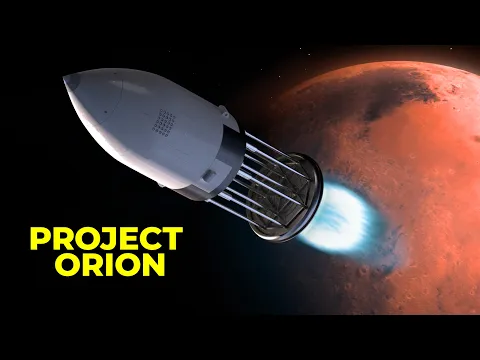
Earth to Mars in 10 Days follows the specific people, circumstances and claims presented in this full-length documentary. Select imagery/video supplied by Getty Images Thank you to AP Archive for access to their archival footage. Thank you to my patreon supporters: Abdullah Alotaibi, Adam Flohr, Henning Basma, Hank Green, William Leu, Tristan Edwards, Ian Dundore, John & Becki Johnston. Nevin Spoljaric, Jason Clark, Thomas Barth, Johnny MacDonald, Stephen Foland, Alfred Holzheu, Abdulrahman Abdulaziz Binghaith, Brent Higgins, Dexter Appleberry, Alex Pavek, Marko Hirsch, Mikkel Johansen, Hibiyi Mori. Viktor Józsa, Ron Hochsprung
Real Engineering
How NASA Reinvented the Rocket Engine follows the specific people, circumstances and claims presented in this full-length documentary. Links to everything I do: References: Select imagery/video supplied by Getty Images Thank you to AP Archive for access to their archival footage. Thank you to my patreon supporters: Abdullah Alotaibi, Adam Flohr, Henning Basma, Hank Green, William Leu, Tristan Edwards, Ian Dundore, John & Becki Johnston. Nevin Spoljaric, Jason Clark, Thomas Barth, Johnny MacDonald, Stephen Foland, Alfred Holzheu, Abdulrahman Abdulaziz Binghaith, Brent Higgins, Dexter Appleberry, Alex Pavek, Marko Hirsch, Mikkel Johansen, Hibiyi Mori. Viktor Józsa, Ron Hochsprung
Real Engineering
NASA'S Plutonium Problem follows the specific people, circumstances and claims presented in this full-length documentary. Select imagery/video supplied by Getty Images Thank you to AP Archive for access to their archival footage. Thank you to my patreon supporters: Abdullah Alotaibi, Adam Flohr, Henning Basma, Hank Green, William Leu, Tristan Edwards, Ian Dundore, John & Becki Johnston. Nevin Spoljaric, Jason Clark, Thomas Barth, Johnny MacDonald, Stephen Foland, Alfred Holzheu, Abdulrahman Abdulaziz Binghaith, Brent Higgins, Dexter Appleberry, Alex Pavek, Marko Hirsch, Mikkel Johansen, Hibiyi Mori. Viktor Józsa, Ron Hochsprung
Real Engineering
From drought-hit rice farms in Thailand to threatened rainforests in Indonesia, this documentary explores the pressures on our food supply. Meet scientists developing heat-resistant vegetables, farmers building sustainable fish ponds and businesses rescuing unwanted produce. Could smarter farming, more diverse crops and less waste help feed a growing planet?
Naked Science
Send a Thank You to the Director: Listen to the Soundtrack: For one glorious summer, an experimental, sci-fi band rocked Disneyland's space stage. With a bass-playing Wookie and an acrobatic frog, the band's existence is nearly unbelievable, and the story behind its creation is just as incredible. Please enjoy. Email: Buy Defunctland T-Shirts: Donate on Patreon: Defunctland Twitter: Defunctland Subreddit: For more great content, visit defunctland.com
DefunctlandTravel from the Solar System to black holes, galaxies and the early universe through full-length space documentaries. The collection also covers telescopes, planetary missions and the engineering required to explore beyond Earth.
Separate measured discoveries from predictions and speculative headlines. Strong films explain which observations support an idea, how instruments collect data and where uncertainty limits what scientists can conclude.
Every documentary opens in an official original platform player and includes a synopsis, clear source attribution and viewing information. Browse the complete selection above or use the category menu to explore another subject.